This September, the 12th edition of the Women Over 50 Film Festival kicks off. We’re online for one month (get tickets here), from 4 September to 5 October, and the programme of 54 films is locked in.
WOFFF is programmed each year by our Festival Team with the support of official WOFFF selectors who watch and give feedback on all the films submitted. This year that was over 370 films from 19 different countries.
We never set out to programme the festival around a specific ‘theme’; we prioritise the films first, then see what unfolds.
So, of course, we didn’t set out to programme a festival about ‘care’. But when we looked across the selection, we kept finding it.
Not only caring for another person, although there’s plenty of that. There are films about caring for a recipe that might disappear, a patch of land, a collection of toys, our oceans, planet and wildlife, a community’s history, a sister, a mother, a stranger. And so much more.
Caring for traditions and memories
Now That's What I Call Dock Pudding, dir. Sarah Mason
Take Now That’s What I Call Dock Pudding (dir. Sarah Mason). The World Dock Pudding Championships take place every year in Mytholmroyd, West Yorkshire, where competitors cook a local dish made from dock leaves. There are secret picking spots, closely guarded recipes, sizzling pans, a brass band and some very serious judging. Sarah Mason first visited the championships years ago and has wanted to make a film about them ever since. As fewer people learn the recipe, there’s also a question about how long the tradition will continue.
Birgitte (dir. Maria Zaikina) takes us to Berlin, where Birgitte lives among hundreds of children’s toys collected over many years. For Maria, collecting can be a way of resisting disappearance: holding onto fragments of memory and making order from the things we choose to keep.
Caring for others
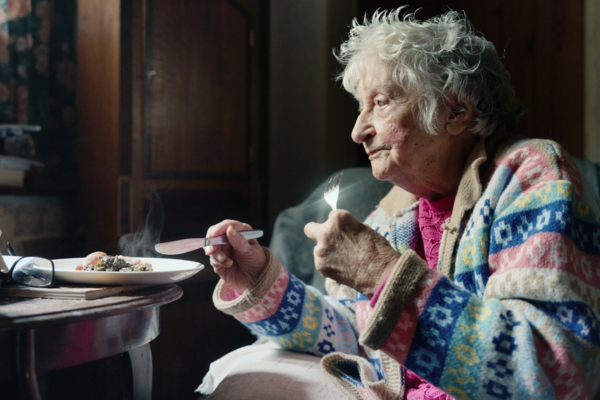
In Muddled Meals (dir. Christie Arnold), Sandra is worn out from caring for her mother, Bev, who is living with dementia. The film is about one of the hardest decisions in caring for someone: knowing when to ask for help.
Isolated Silence(dir. Vicente Garibay Lijanova) pushes a similar problem much further. Ariadna can’t afford the care her sister need and so starts stealing food from supermarkets.
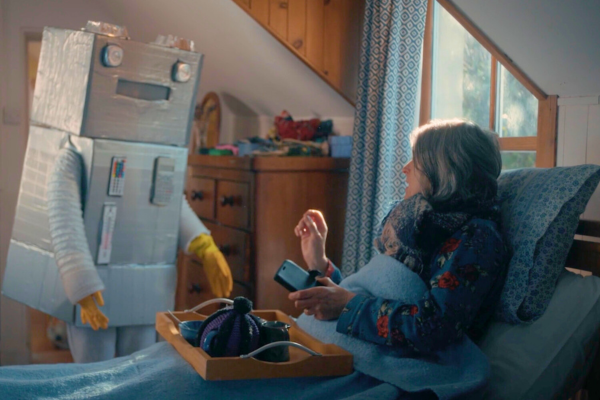
Then there’s ICare 9000 (dir. Robert Duncan), which offers another solution: replace the carer with a robot.
Except this particular high-tech robot was made with cardboard boxes and duct tape.
Robert describes ICare 9000 as a deliberately handmade, imperfect film. He made it with a small crew, borrowed camera equipment and a few cardboard boxes covered in duct tape. The comedy sits alongside some fairly serious concerns about AI, loneliness and an underfunded care system.
ICare 9000, dir. Robert Duncan
Caring for our communities
In Spiders (dir. Benjamin Cook), a group of older women in north-eastern Ukraine knit camouflage nets for soldiers on the front line. Benjamin had previously worked with older patients in the ambulance service and was interested in how often older people are reduced to being vulnerable or helpless. The women he met in Ukraine didn’t fit that description. They wanted to do something useful and this was their way of doing it.
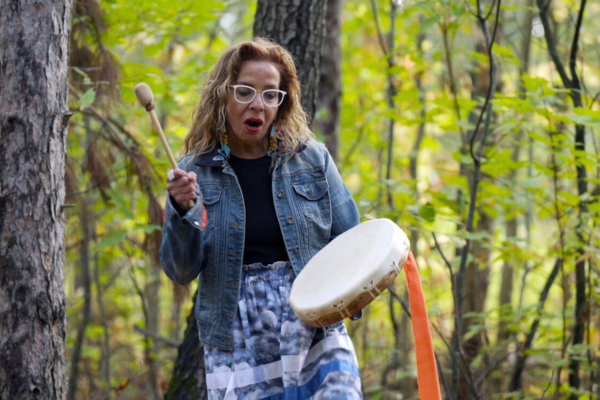
Red Girl Rising (dirs. Kim Stadfeld and Faith Howe) follows Mohawk matriarch, retired teacher and activist Joyce Jonathan Crone. Joyce calls her approach ‘Reconcili-action’: creating practical opportunities for Indigenous education, allyship and understanding in her community.
Gertie Hooper VS the Committee, dir. Melissa Herman
Red Girl Rising, dirs. Kim Stadfeld and Faith Howe
Gertie Hooper VS the Committee (dir. Melissa Herman) goes back to the Second World War, when Gertie finds herself fighting to protect the family farm after the men of her village decide to sacrifice it to aid the war effort.
Care for a place can be very literal too. In Old Ladies Against Underwater Garbage (dir. Liz McGregor), Susan Baur and a group of women aged 65 to 86 swim through the freshwater ponds of Cape Cod collecting whatever they find on the bottom: beer cans, golf balls, fishing lures, dog toys, shoes and occasionally a tyre or mobile phone. Susan says it’s their affection for the fish, turtles and plants keeps them going. “Well, that and cookies.”
New Ground, dir. Louisa Rechenbach
And in New Ground (dir. Louisa Rechenbach), 26 women over 50 are creating their own co-housing community.
Director Louisa Rechenbach already lives collectively herself, in an intergenerational housing co-op in London. In New Ground, she follows women who have chosen to create a community where they can live independently while still knowing and supporting the people around them as they get older.
Of course, that’s only one thread running through WOFFF26.
Among the other films are awkward encounters in photo booths, retirement plans that go badly wrong, artists, whistleblowers, tattoos, family arguments, lost things, found things and a woman who really does not want to learn to swim.
The full programme
Get a Festival Pass for WOFFF26 Online
The online programme is split into eight collections, and your Festival Pass gives you access to all 55 films for the whole month. You can work through the collections, browse the films individually or head straight to this year’s Judges’ Shortlist.
WOFFF26 Online runs from Friday 4 September to Monday 5 October 2026. An Online Festival Pass gives you a full month to watch all 54 films, online and on demand, from anywhere in the world.